
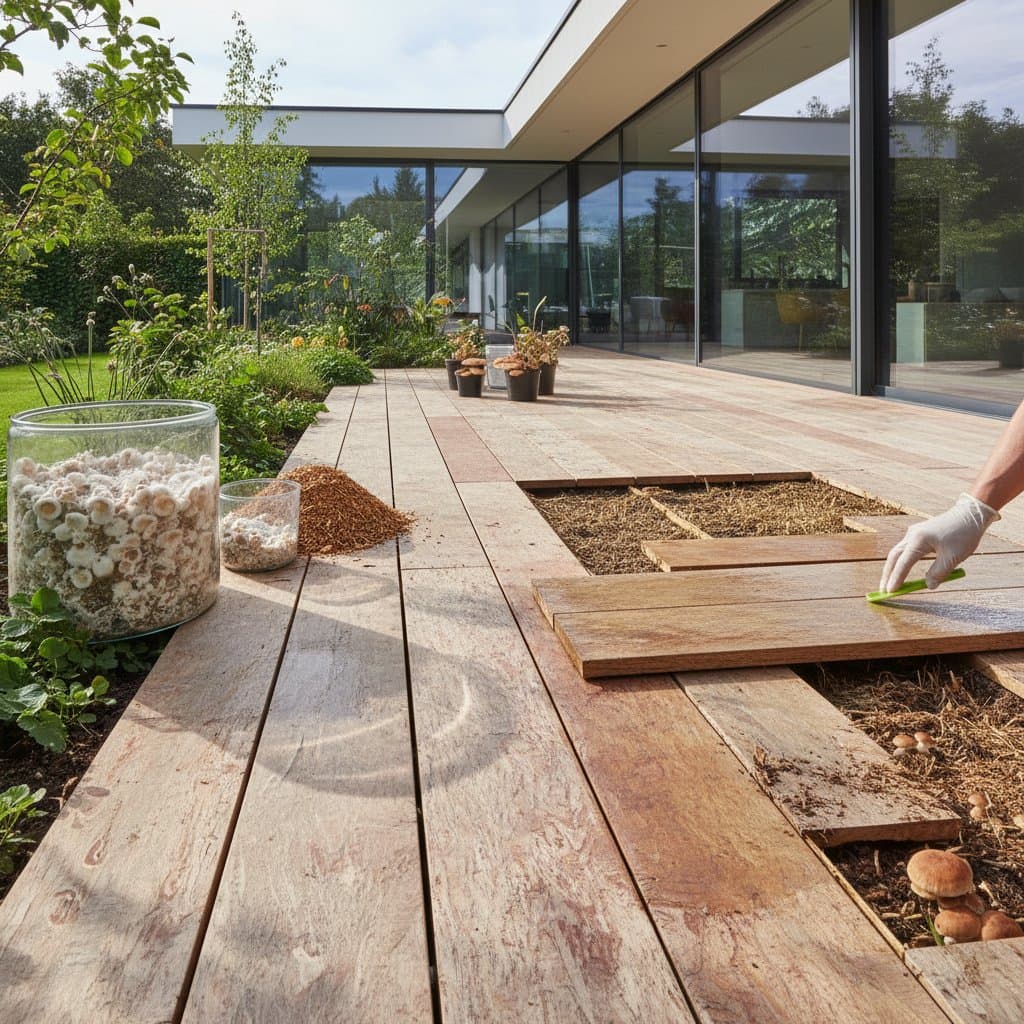
Revolutionizing Outdoor Spaces with Mycelium Decking Boards
Composite decking transformed backyards in the past. A more sustainable evolution emerges today. Mycelium-based boards, cultivated from fungal networks, deliver lightweight, resilient, and completely biodegradable decking options. These materials function as self-growing lumber alternatives.
The objective remains straightforward: construct enduring outdoor areas that withstand environmental stresses, then decompose harmlessly at the end of their service life. This guide details the nature of mycelium decking boards, their operational principles, and practical applications for developing an environmentally conscious deck in residential settings.
Understanding Mycelium Decking
Mycelium represents the underground root structure of fungi. It acts as a biological binder, fusing wood chips or plant-based fibers into a compact, sturdy composition. Subjected to compression and thermal curing, the mixture solidifies into panels comparable to engineered wood products.
In decking applications, mycelium integrates with reinforcements like hemp, flax, or sawdust to enhance structural integrity. Production involves cultivating the material within reusable molds, followed by curing and precision cutting into plank dimensions. The finished product resembles light-toned timber visually but offers a texture akin to cork or bamboo.
This innovation carries significant implications. Conventional decking frequently incorporates plastics or tropical hardwoods, which deplete forests and generate persistent waste. Mycelium boards circumvent these issues by utilizing agricultural waste streams, requiring minimal energy for production, and breaking down entirely through composting processes.
Essential Tools and Materials
For assembling a compact patio or balcony with mycelium decking, assemble the following items prior to commencement:
- Mycelium decking boards: approximately 10 to 15 units for a 100-square-foot installation.
- Subframe components: pressure-treated pine lumber or recycled composite joists, positioned at 16-inch (40 cm) intervals.
- Stainless steel fasteners: one box of 2.5-inch (6 cm) deck screws.
- Power drill with bit assortment for creating pilot holes and countersinks.
- Spirit level and measuring tape to verify alignment and gradient.
- Protective gloves and respiratory mask for handling cuts, as particulate fibers may cause irritation to skin and airways.
- Eco-friendly sealant or beeswax-based finish to shield against weathering.
Such a project typically incurs costs of 8 to 10 dollars per square foot, approximately half the expense associated with exotic hardwoods.
Installation Process
1. Site Preparation
Remove vegetation and debris from the area, then level the surface. Install a layer of gravel or permeable pavers to facilitate drainage. Ensure the slope directs water away from the foundation to avoid accumulation that could compromise both the substructure and mycelium components.
2. Frame Construction
Position joists at 16-inch (40 cm) centers and secure them using galvanized metal brackets. Confirm levelness across the assembly. A robust frame prevents undue flexing or fracturing of the boards under regular use.
3. Board Cutting and Placement
Take precise measurements before any cuts. Employ a blade with fine teeth on softer mycelium boards to achieve clean edges without splintering. Don protective eyewear and a mask during this phase.
4. Securing the Boards
Pre-drill holes to avert splitting. Fasten with corrosion-resistant stainless steel screws. Maintain a 1/8-inch (3 mm) separation between adjacent planks to accommodate natural expansion and promote water runoff.
5. Surface Finishing
Apply a uniform layer of natural sealant using a brush. This treatment guards against humidity and ultraviolet radiation. Allow a minimum of four hours for drying before applying load; select non-toxic options that permit material respiration.
Safety Considerations
Wear gloves at all times when manipulating untreated boards, as surface particles may release. Install only in dry conditions to prevent subsurface dampness from compromising strength. Avoid proximity to ignition sources, given the organic composition of the material. Conduct preliminary tests on sealant samples to evaluate compatibility and visual outcomes.
Common Issues and Resolutions
Warping or Deformation: Inspect for irregular joist placement or moisture retention. Remove affected boards, facilitate drying, and refit with adequate gaps.
Yielding Areas: Probe spongy sections for underlying water buildup. Enhance ventilation through perimeter gaps or dedicated air channels.
Discoloration: Renew with natural oil applications biannually to revitalize appearance and fortify against solar degradation.
Fungal Stains: Treat with a solution of one cup white vinegar per gallon of warm water. Gently abrade with a soft-bristled brush, rinse thoroughly, and dry completely prior to refinishing.
Project Timeline and Costs
Construct a 10-by-10-foot deck over two weekends with a team of two. Expect material expenditures of 800 to 1,000 dollars, influenced by board grade and protective coatings. The reduced weight simplifies handling and minimizes equipment strain.
Professional services may charge 5 to 8 dollars per square foot for labor. Verify the contractor's familiarity with bio-materials, as expertise influences durability outcomes.
Ongoing Care
Mycelium decking demands moderate attention compared to untreated softwoods, though it exceeds synthetics in maintenance needs. Schedule weekly sweeping to eliminate debris and prevent dampness. Perform gentle cleaning with diluted soap quarterly.
Reapply protective oils or sealants twice annually in moist environments, or once in arid zones. Annually examine fasteners for security and replace as necessary. At lifecycle conclusion, dismantle and compost in a managed heap; decomposition occurs within months in optimal warmth and humidity.
Proper Storage Practices
Store surplus boards horizontally on an elevated, arid indoor platform. Avoid direct contact with concrete to prevent moisture migration. Interleave stacks with slender wood separators to promote airflow, thereby prolonging usability for subsequent projects.
Professional Assistance Indicators
Engage experts for elevated or structurally integrated decks to guarantee adequate bearing capacity and waterproofing. Request documentation of prior work with sustainable composites, client testimonials for innovative installations, and detailed strategies for joint and edge protection.
Observing Performance and Sharing Insights
Monitor tactile comfort, post-rain drying efficiency, and long-term weathering patterns. Document these experiences to inform community discussions or guide local fabricators.
Selecting mycelium boards minimizes environmental footprint, lowers carbon output, and embraces circular principles where materials originate from and revert to the earth. Assemble with care, maintain diligently, and allow natural reclamation at the end.