
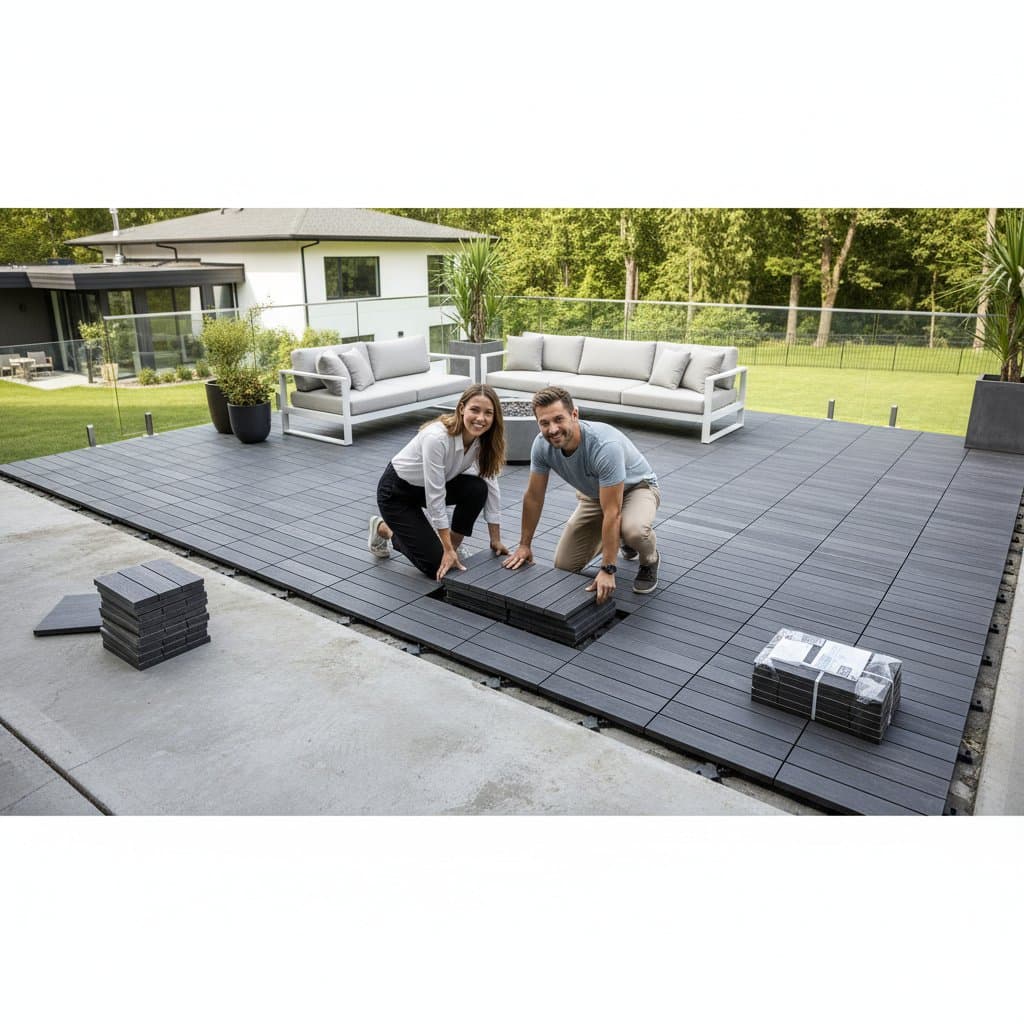
6. Install Edge Pieces
Position border strips or transition ramps if available from the manufacturer. These elements minimize trip risks and create a polished appearance at junctions with bare soil or doorways.
Secure them by snapping into the adjacent tiles. Ensure alignment for a seamless transition that withstands foot traffic.
7. Check for Movement
Traverse the entire surface to assess stability. Pay attention to any clicking or creaking sounds.
If a tile shifts, remove it carefully, remove any debris from the connection points, and firmly reseat it. The assembly must remain secure while allowing slight flexibility for thermal expansion and contraction.
Safety Tips
- Prevent slippery installations. Refrain from placing tiles on damp or frozen surfaces, as connections may fail to engage correctly.
- Secure boundaries. Apply border trims wherever the flooring terminates above ground level to eliminate tripping dangers.
- Guard against pinches. Assemble tiles on a stable, level plane rather than while holding them elevated.
- Verify weight capacities. For elevated structures like balconies or roofs, ensure the total load from tiles and furnishings complies with building specifications.
Troubleshooting
Problem: Tiles dislodge following intense rainfall.
Cause: Inadequate drainage or irregular substrate. Elevate the impacted area, examine for standing water or obstructions, and reposition on a drier, even foundation. Incorporate gravel layers if drainage improves the setup.
Problem: Color diminishes over time.
Cause: Extended ultraviolet exposure. Many formulations incorporate stabilizers, yet minor fading occurs in the initial year. Shift tiles periodically between shaded and exposed zones to promote uniform patina development.
Problem: Gaps appear uneven.
Cause: Improper connector alignment or accumulated residue. Disassemble the tiles, cleanse the undersides thoroughly, and reassemble beginning from the most linear boundary.
Problem: Surface emits a hollow tone underfoot.
Cause: Void between tiles and substructure. For wooden decks, confirm joist integrity. Over concrete slabs, apply a self-leveling compound to low spots prior to replacement.
Budget and Time Considerations
Tool-free composite pavers typically range from $5 to $8 per square foot, varying by manufacturer, hue, and surface finish. Completing a 60-square-foot balcony requires approximately 1.5 hours. Larger projects, such as a 200-square-foot patio, demand 4 to 6 hours, accounting for any necessary adjustments.
Key expense factors include:
- Thickness of tiles and established brand quality
- Freight charges due to material density
- Additional components like edging or custom designs
Reserve at least one extra box in a protected indoor location for eventual replacements. Matching hues proves simpler with tiles from identical production runs.
Maintenance Practices
Composite construction resists decay and fragmentation, yet routine attention preserves pristine condition.
Monthly routines:
- Brush away loose particles and hose down the surface.
- Inspect connection points for embedded particles that hinder secure attachment.
Seasonal maintenance:
- Clean annually with gentle detergent and a non-abrasive brush.
- Randomly lift select tiles to verify dryness beneath.
- In regions with freezing temperatures, employ plastic tools for snow clearance to avoid surface damage.
Repair procedures:
To replace a fractured tile, insert a flathead screwdriver at one edge to detach it gently. Insert the substitute and realign neighboring connections for full integrity.
Seasonal Considerations
Weather extremes challenge exterior surfaces, but composites endure well with proactive measures.
Prior to heavy precipitation:
Ensure gutters and drainage paths remain unobstructed. Avoid water accumulation below the tiles.
Ahead of winter conditions:
Clear and wash the area, allowing complete drying. Prevent edge uplifting from frozen moisture.
In preparation for prolonged warmth:
Examine clearances adjacent to fixed structures. Maintain a minimum 1/4-inch (6 mm) separation for heat-induced shifts.
Following severe weather:
Scan for shifted tiles or lodged debris in seams. Prompt removal averts potential distortion.
Storage Strategies
For temporary or mobile setups, dismantle and store pavers for future use. Stack in flat bundles of six to eight units. Enclose each bundle in protective sheeting or a container to shield connectors.
Avoid prolonged sun exposure during storage to prevent deformation. Organize stacks with labels indicating origin, such as balcony perimeter sections, to streamline reassembly. An individual can transport roughly 25 square feet per load, given each tile weighs about 2 pounds.
Professional Assistance Indicators
Homeowners handle most installations independently, yet certain scenarios warrant specialist involvement.
Seek expert aid when:
- The base exhibits over 1 inch (2.5 cm) of incline across every 4 feet.
- Visible fissures appear in the underlying deck or slab.
- Integration of features like illumination, drainage, or barriers intersects the paver layout.
Professionals assess bearing capacities and apply moisture barriers at perimeters. Installation fees generally span $3 to $5 per square foot for comprehensive service.
Expert Recommendations
- Prepare materials in advance. Distribute tiles from multiple packages to distribute natural color variances evenly.
- Maintain perpendicular alignment. Verify squareness at intervals of 3 feet using a straightedge or marking tool.
- Incorporate perimeter finishes. Border elements enhance aesthetics and safeguard joints from abrasion.
- Preserve extras in controlled environments. Environmental fluctuations may subtly affect tint over extended periods.
- Clear seams with flexible tools. Select plastic implements to prevent scratches on the material.
These practices ensure enduring stability and visual appeal.
Implementation Guide
Achieve a refreshed outdoor area in a single session using only manual effort, basic cleaning tools, and paver supplies. Begin modestly by testing a 4-by-4-foot sample to gauge comfort and assembly speed. Confidence gained supports full-scale application.
Initiate with these steps:
- Dimension the area and draft a preliminary arrangement.
- Evaluate samples from select brands for tactile and visual suitability.
- Procure sufficient quantity for uninterrupted coverage to sustain design consistency.
Thorough site preparation and methodical progress yield a professional-grade result without specialized equipment, debris, or complications.