
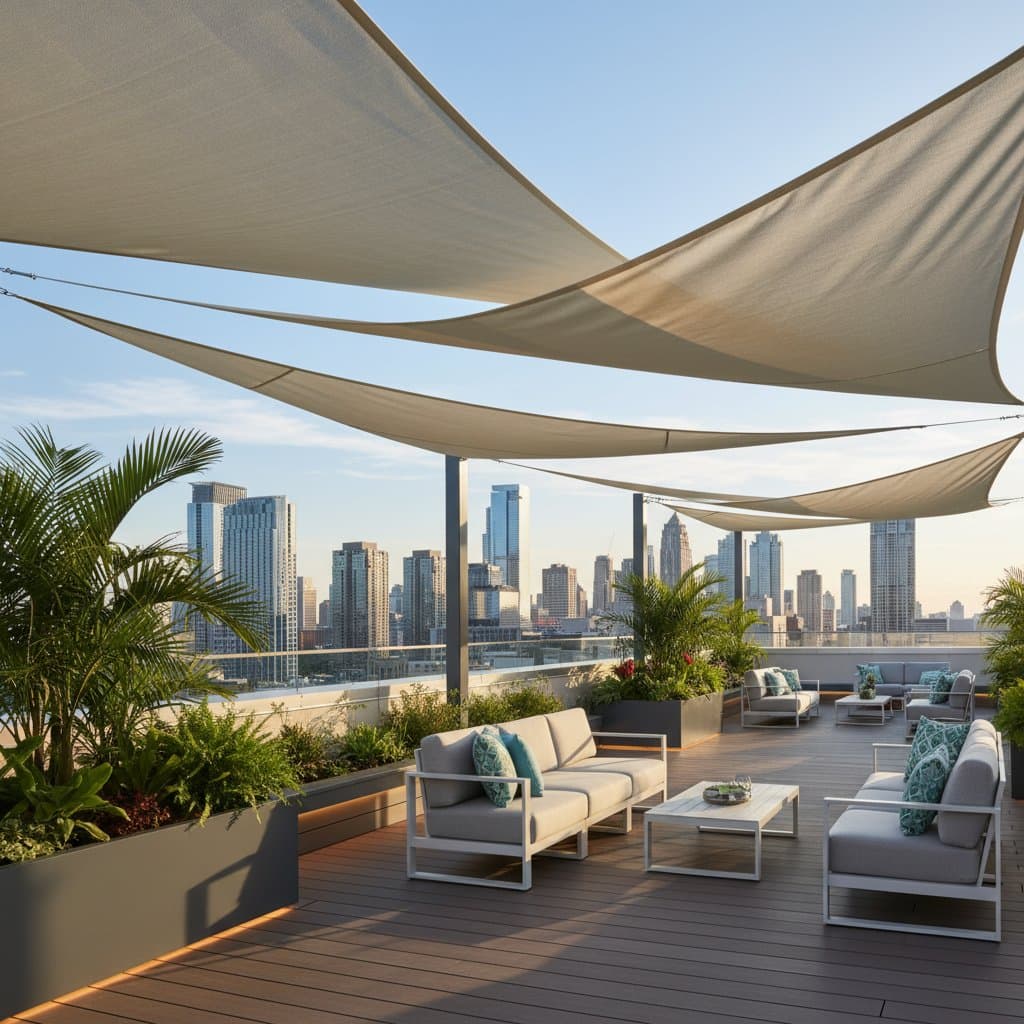
Rooftop Decks Remain 40 Percent Cooler with Shade Sails
Urban summers intensify the challenge of enjoying rooftop spaces, where deck surfaces often reach scorching levels that warp wood and heat metal railings to discomfort. Shade sails address this issue by decreasing surface temperatures by up to 40 percent, transforming the area into a practical retreat throughout the season. This guide details the mechanics of shade sails, essential installation components, and strategies for ensuring safety and longevity.
The focus remains on achieving a cooler, more inviting rooftop environment through accessible fabric solutions and minimal equipment.
Overview
A shade sail consists of a tensioned, UV-resistant fabric secured to poles or walls to intercept sunlight. The material weaves in a way that reflects or absorbs solar radiation, preventing it from warming the deck below. This approach yields lower temperatures, diminished glare, and extended durability for outdoor furnishings.
Shade sails typically appear in triangular or rectangular forms. Their permeable structure permits airflow, providing shade without retaining warmth beneath. In airflow-restricted urban settings, this configuration maintains comfort without imposing cumbersome additions.
Key Benefits
- Temperature reduction of up to 40 percent on deck surfaces and surrounding air.
- UV blockage ranging from 85 to 95 percent of damaging rays.
- Potential energy conservation when shading occurs near windows or HVAC systems.
- Lightweight assembly that eliminates the need for robust framing.
- Aesthetic enhancement through varied fabric hues and clean lines.
Tools and Materials
Installation of a shade sail requires no specialized carpentry expertise, though secure anchor points and tensioning components prove essential. Assemble the following before beginning:
- Shade sail dimensioned for the intended area, often 10 to 16 feet per side for triangular models.
- Mounting hardware kit including turnbuckles, pad eyes, and snap hooks.
- Stainless steel bolts or lag screws suitable for exterior conditions.
- Support poles, measuring 8 to 10 feet in height, if wall attachments prove insufficient.
- Measuring tape extending at least 25 feet.
- Drill equipped with bits for masonry or wood, based on the anchoring surface.
- Ladder and safety harness for decks with exposed edges.
- Wrench for securing fittings.
Steps
These instructions ensure a stable and even installation. Enlist an assistant for larger sails, as wind may influence handling.
Step 1: Plan the Layout
Identify the shading zone and mark it with chalk or tape. Orient the sail so the highest edge aligns with the sun's trajectory. Such positioning facilitates the upward and outward dispersal of warm air.
Step 2: Measure Anchor Points
Calculate distances between fixation sites. Account for 10 to 12 inches of additional length per corner to accommodate hardware extension and tension. Maintain tautness without excessive strain.
Step 3: Install Hardware
Affix pad eyes or eye bolts to robust elements like parapet walls, beams, or posts. Select anchors supporting at least 100 pounds per corner. For masonry, employ sleeve anchors and apply silicone sealant to drilled openings to avert water intrusion.
Step 4: Raise the Sail
Attach corners via snap hooks and turnbuckles. Adjust turnbuckles uniformly to eliminate wrinkles and sagging. Verify that the configuration slopes to allow water runoff from one side, avoiding central accumulation.
Step 5: Secure and Test
Tug lightly on connections to verify firmness. Position oneself below to assess shade distribution. Modify angles if direct light persists in critical zones.
Safety Tips
- Steer clear of power lines and ventilation units during pole placement or drilling.
- Refrain from using unsteady railings; rely on a stable ladder and harness.
- Review the fabric's wind tolerance, typically up to 35 miles per hour; dismantle the sail ahead of storms.
- Examine metal components for corrosion or wear at the season's outset.
Troubleshooting
Minor adjustments may arise shortly after setup.
Sagging Fabric
To correct sagging, rotate turnbuckles one or two full turns at each corner. Imbalanced tension often leads to moisture collection or billowing.
Water Pooling
Elevate one anchor 6 to 12 inches above its counterpart to establish drainage. This adjustment promotes efficient water shedding.
Loose Anchors
Should anchors loosen, opt for larger fasteners or incorporate backing plates for reinforcement. Exterior walls demand anchors beyond drywall varieties.
Maintenance
Regular upkeep preserves the sail's integrity and vibrancy.
- Clean the fabric quarterly using mild soap and a soft brush, followed by a complete rinse to eliminate residues.
- Apply silicone spray to metal parts annually to inhibit rust.
- Reassess tension each month, as materials may elongate gradually.
- Scan seams for wear and mend with UV-resistant thread as required.
Storage
Remove the sail during cooler periods or anticipated high winds.
- Release turnbuckles and detach corners in the reverse sequence of assembly.
- Thoroughly wash and dry the fabric prior to folding.
- Place it in a breathable container within a dry interior location.
- Organize hardware in a dedicated holder for straightforward retrieval.
This method wards off mildew and material degradation, ensuring readiness for subsequent use.
Budget and Time
A shade sail system covering approximately 120 square feet ranges from 150 to 400 dollars, influenced by fabric grade and fittings. Custom or expansive options may approach 700 dollars.
One-person installation spans two to four hours for a single unit, extending to a full day for arrays. Professional services incur an additional 200 to 300 dollars, covering labor and equipment.
When to Call a Professional
Engage a licensed expert for rooftops featuring concrete barriers, intricate configurations, or sparse anchors. Inquire about:
- Anchor load-bearing capacity.
- Overall wind resistance.
- Strategies for water diversion to safeguard the roof.
- Warranties on materials and upkeep protocols.
Professionals excel in orchestrating multi-sail arrangements that optimize balance and coverage on expansive decks.
Seasonal Reminders
At the onset of warmer weather, evaluate the entire setup. Substitute any deteriorated hardware and test anchor security. Pre-installation cleaning removes debris that could damage fibers.
During inclement seasons, dismantle the sail to mitigate stress from precipitation or accumulation. Shield fittings with a thin oil layer for protection.
Expanding Your Shaded Retreat
Begin with a single sail to gauge effectiveness against your comfort needs. If satisfactory, incorporate additional units. Select pale shades to maximize light reflection and ventilation.
A rooftop deck 40 percent cooler elevates usability, conserves energy, and amplifies year-round outdoor pleasure.