
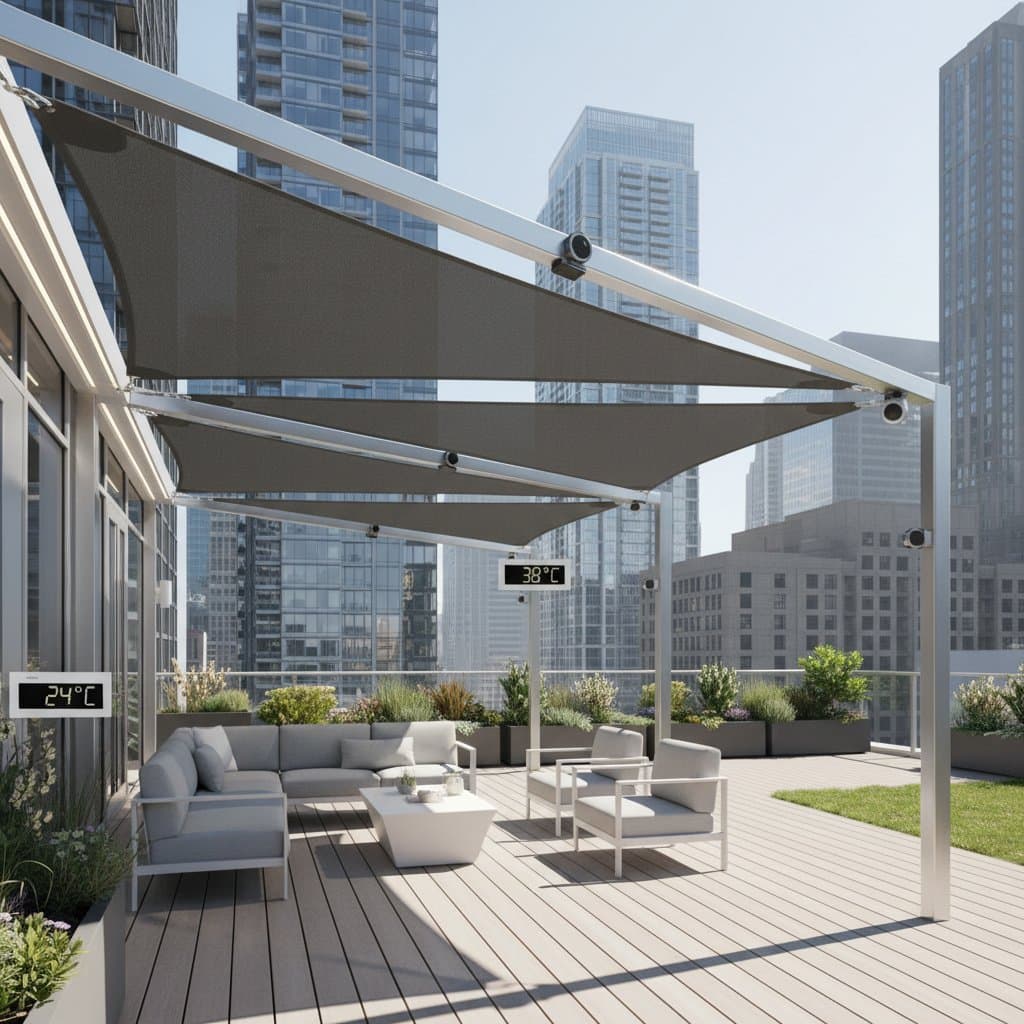
Smart Shade Sails Reduce Rooftop Temperatures by 30 Degrees
Urban rooftops absorb intense sunlight, creating uncomfortable heat that affects relaxation areas and increases indoor temperatures. Deck surfaces become scalding, and the radiant warmth seeps into living spaces below, straining cooling systems. Smart shade sails address this challenge by automatically adjusting to the sun's position, providing consistent coverage without manual intervention. This approach delivers targeted shade that enhances comfort and efficiency.
In this guide, readers discover the mechanics of smart shade sails, their impact on rooftop environments, and practical installation methods. The focus remains on achieving reliable performance through careful setup and ongoing care. By the end, users gain confidence to implement these systems for cooler, more enjoyable outdoor spaces.
Understanding Smart Shade Sails
A smart shade sail consists of a durable fabric canopy integrated with sensors and a motorized control system. The sensors detect the sun's angle and intensity, prompting the motor to adjust the sail's position for optimal coverage. Advanced models connect to weather data sources, retracting during gusty winds or storms to prevent damage.
These systems maintain ventilation while blocking direct rays, which lowers surface temperatures by 20 to 30 degrees Fahrenheit, or 11 to 17 degrees Celsius. Such reductions decrease indoor heat buildup by as much as 15 percent, easing the load on air conditioning units. Additionally, the UV-resistant material preserves outdoor furnishings by minimizing sun exposure and color degradation.
Essential Tools and Materials
Installing a compact automated shade sail requires straightforward equipment. For a setup covering approximately 120 square feet, or 11 square meters, gather these items:
- Smart motor kit powered by solar panels or electrical outlet
- Two to four galvanized mounting poles or heavy-duty wall brackets
- High-density UV-resistant fabric sail with a minimum weight of 160 grams per square meter
- Wireless control hub compatible with smartphone applications
- Corrosion-resistant stainless steel turnbuckles and high-tensile cords
- Secure weatherproof wiring clips and connectors
- Basic tools including a sturdy ladder, precision tape measure, adjustable wrench, and power drill with masonry bits
Before proceeding, evaluate the rooftop's structural elements, such as concrete slabs or parapet walls, to confirm they support the intended load. Many manufacturer kits provide alignment templates to ensure proper positioning during assembly.
Installation Process
Planning and Measurement
Begin by assessing the target shading area. Account for a 12-inch, or 30-centimeter, buffer around the sail's perimeter to promote air circulation and prevent moisture buildup. Identify anchor locations that create a stable geometric shape, such as a triangle for single sails or a trapezoid for broader coverage, to distribute tension evenly.
Sketch the layout on paper or use a digital tool to simulate sun paths throughout the day. This step confirms the sail aligns with peak sunlight hours, maximizing cooling benefits.
Securing Anchor Points
Position the brackets or poles at predetermined spots. Drill pilot holes using bits suited to the surface material, then insert stainless steel expansion bolts designed for exterior applications. Partner with another individual to steady the ladder, and equip yourself with protective gloves and safety glasses throughout the process.
Test each anchor's hold by applying gradual pressure; it should withstand at least twice the sail's weight plus wind forces. Secure all connections tightly to avoid future loosening.
Attaching the Fabric Canopy
Connect the sail's reinforced corners to the anchors via turnbuckles. Gradually increase tension until the fabric forms a taut, slightly concave surface that facilitates water runoff. Inspect for even distribution, adjusting as needed to eliminate sagging edges.
Avoid over-tightening, which could stress seams or hardware. Once set, the sail should withstand light breezes without shifting.
Integrating the Motor System
Mount the motor unit to a primary anchor, typically at a corner with the greatest movement range. Route the tension cord from the motor to the corresponding sail attachment, ensuring smooth operation without kinks. Connect to the power supply, whether solar or wired, and synchronize the control hub with the home network via the provided application.
Verify all electrical components meet local codes, using grounded outlets for plug-in models.
Sensor Calibration
Access the control interface through the app or device panel to define the sail's default orientation. Initiate a full tracking sequence to observe adjustments in response to simulated light changes. Fine-tune rotation boundaries to prevent excessive strain on the mechanism.
Recalibrate periodically, especially after seasonal shifts, to maintain accuracy in sun tracking.
Safety Considerations
Route all cables and cords overhead or along railings to eliminate ground-level hazards. Postpone installation during periods of strong winds exceeding 20 miles per hour. For shared or regulated rooftops, obtain approval from building management regarding height limits and access protocols.
In multi-unit setups with several motors, engage a certified electrician to handle electrical integrations and perform load-bearing assessments. Regular inspections prevent potential failures that could compromise structural integrity.
Common Issues and Solutions
If the sail appears slack or vibrates excessively, inspect the tension lines and fixation points. Re-secure turnbuckles in a balanced manner, alternating sides until stability returns.
When the motor hesitates or halts, remove any accumulated dirt from the guide rails. Confirm the power supply delivers consistent voltage without fluctuations.
For inaccurate light detection, wipe the sensor surface gently with a microfiber cloth. Reposition away from shiny objects that might cause false readings.
Connection failures with the app often stem from signal interference; reboot the hub and position it no farther than 30 feet, or 9 meters, from the Wi-Fi router.
Cease operation immediately if unusual noises like grinding occur, and consult the manufacturer for diagnostics. Disconnect power sources prior to any hands-on examinations in electrically linked installations.
Routine Maintenance Practices
Every few months, rinse the sail with a solution of mild detergent and lukewarm water. Steer clear of abrasive cleaners or bleach, as they degrade protective coatings. Examine attachment hardware for signs of oxidation or fiber wear, replacing components promptly.
Apply a light coat of silicone lubricant to pivoting joints to ensure fluid movement. With proper attention, these systems endure five to ten years of service.
Clear sensor optics regularly to sustain precise automation. Document maintenance logs to track patterns and anticipate part replacements.
Off-Season Storage
Prior to disassembly for winter or storm seasons, allow the sail to air dry completely. Fold neatly following the manufacturer's seam guidelines to avoid creases. Place in a breathable storage pouch within a temperature-controlled, moisture-free environment.
Organize associated hardware in labeled compartments for efficient retrieval. Shield the motor and electronics with fitted protective covers or non-porous wraps to guard against environmental exposure.
Cost Estimates and Timeline
Entry-level kits for modest rooftop sections begin at around 200 dollars, scaling to over 1,000 dollars for expansive or feature-rich configurations. Factors include motor sophistication and fabric durability. A standard installation requires two to four hours of focused effort.
Professional assistance for complex wiring or elevated mounts incurs additional fees but guarantees compliance and longevity. Users often recoup investments through diminished energy costs, as reduced heat lessens reliance on climate control.
The canopy material typically withstands multiple seasons before needing refreshment, depending on exposure levels.
Seasonal Care Guidelines
In spring, scrutinize anchors for deterioration and execute a complete motor diagnostic. During summer peaks, validate sensor responsiveness under full sunlight. Autumn preparations involve safe removal ahead of inclement weather like heavy precipitation or freezing conditions.
Before reactivation, torque all bolts to specifications and test operational cycles. These habits extend system reliability across varying climates.
Professional Assistance Indicators
Seek an electrician for integrations involving damp-prone circuits or building power ties. Structural reviews by engineers prove essential for spans exceeding 200 square feet, or 18 square meters. Consult specialists if proximity to ventilation systems or glass features raises concerns about obstruction or efficiency.
Early involvement of experts mitigates risks and optimizes performance in challenging setups.
Essential Benefits
Smart shade sails deliver automated shade that adapts to daily light patterns, significantly cooling rooftop areas. They promote energy efficiency by curbing heat transfer and protect investments in outdoor amenities. Implementation yields immediate improvements in usability and sustainability.
Implementation Guide
- Evaluate the rooftop section and monitor sunlight trajectories over a full day.
- Choose a kit aligned with spatial dimensions and financial parameters.
- Designate secure anchor sites and verify structural tolerances prior to modifications.
- Validate automated functions post-installation for seamless adjustments.
- Perform regular upkeep through cleaning routines and component checks.