
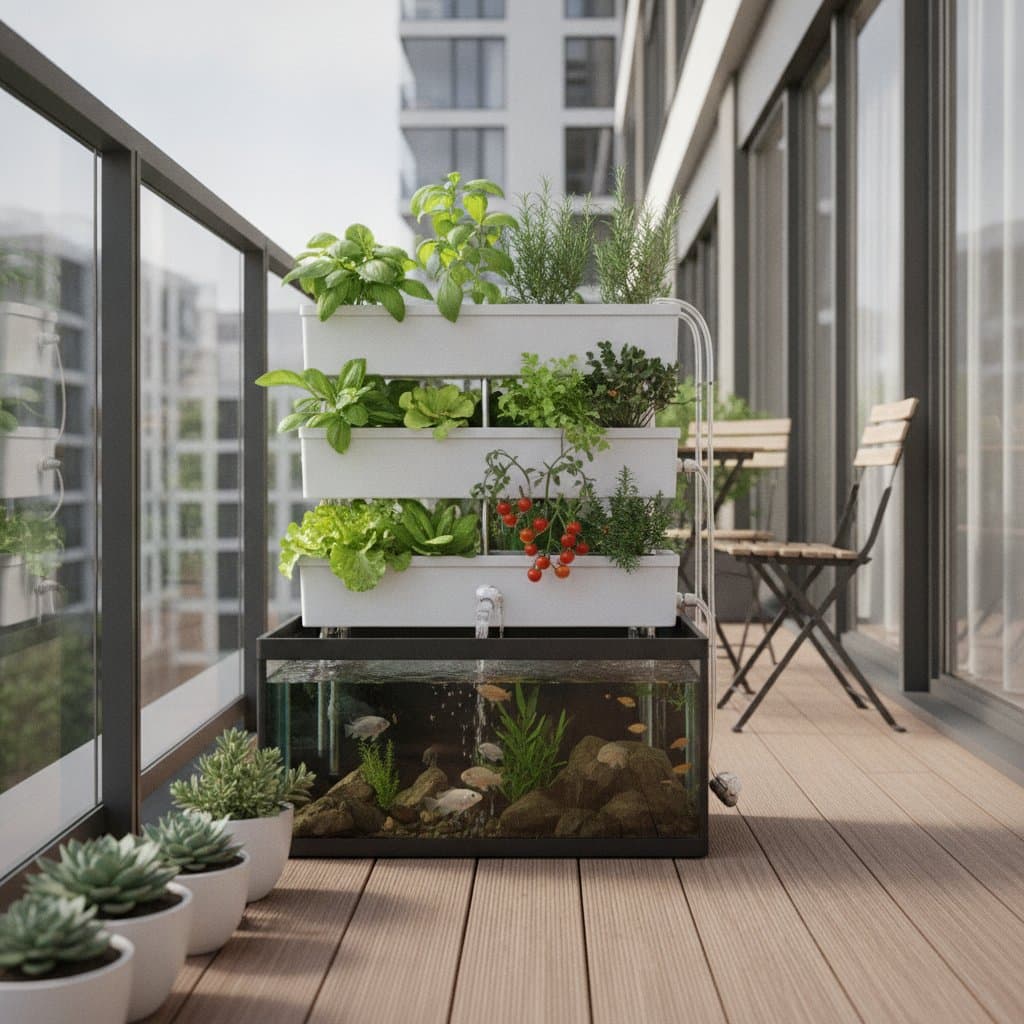
Understanding Balcony Aquaponics
Aquaponics combines fish farming with soil free plant cultivation in one recirculating system. Fish produce waste that beneficial bacteria convert into nutrients for the plants. The plants in turn filter the water before it returns to the fish tank. This closed loop uses up to 90 percent less water than traditional gardening while producing both fresh vegetables and edible fish on a typical apartment balcony.
A compact system fits within a 4 by 8 foot space and supports 10 to 20 fish along with a dozen or more vegetable plants. The setup runs on a small pump and requires only a few hours of monthly attention once established.
Choosing Equipment and Location
Select a food grade tank of 20 to 50 gallons for the fish and a matching grow bed filled with expanded clay pebbles or lava rock. Position the tank on a level section of balcony that receives at least six hours of sunlight or install full spectrum LED grow lights on a timer. Verify that the balcony floor can support the combined weight of water, media, and equipment before assembly.
Install a submersible pump rated for continuous duty and an air stone to maintain oxygen levels. Add a timer to cycle the pump for 15 minutes on and 45 minutes off. This schedule prevents root rot while delivering steady nutrients.
Selecting Fish and Plants
Start with hardy species such as tilapia, goldfish, or koi that tolerate temperature swings common on exposed balconies. Stock at a rate of one inch of fish per gallon of water once the system matures. For plants choose leafy greens, herbs, and fruiting vegetables including lettuce, basil, kale, and cherry tomatoes that thrive in nutrient rich water.
Introduce seedlings rather than seeds to speed establishment. Transplant young plants into net pots or directly into the grow media after roots develop. Monitor new additions for the first week to confirm they receive adequate moisture.
Daily and Weekly Maintenance
Check water temperature, pH, and ammonia levels each morning with a liquid test kit. Keep pH between 6.8 and 7.2 and ammonia below 0.5 parts per million. Top off evaporated water daily and perform a 10 percent water change weekly to control nitrates.
Inspect the pump intake and air stone every seven days for debris. Prune plants regularly to encourage bushy growth and harvest outer leaves to keep production continuous. Observe fish behavior during feeding; reduced appetite often signals an impending water quality issue.
When Professional Service Is Required
Most issues can be handled by careful monitoring, but seek outside help if the tank or stand shows cracks or leaks. Repeated pump failure or tripped breakers also warrant a service call. Sudden unexplained fish deaths require immediate water testing that an aquarium store or aquaponics technician can perform on site.
Repairs typically range from 50 to 100 dollars depending on travel distance and replacement parts. If the balcony requires permanent plumbing or additional electrical circuits, obtain written approval from the building manager before any modifications.
Scaling Production Over Time
After the system runs stably for three months, consider adding a second grow tray or a vertical tower above the existing tank. These additions increase plant capacity without raising water volume or energy use. Track harvest weights for two cycles before expanding further so adjustments remain manageable.