
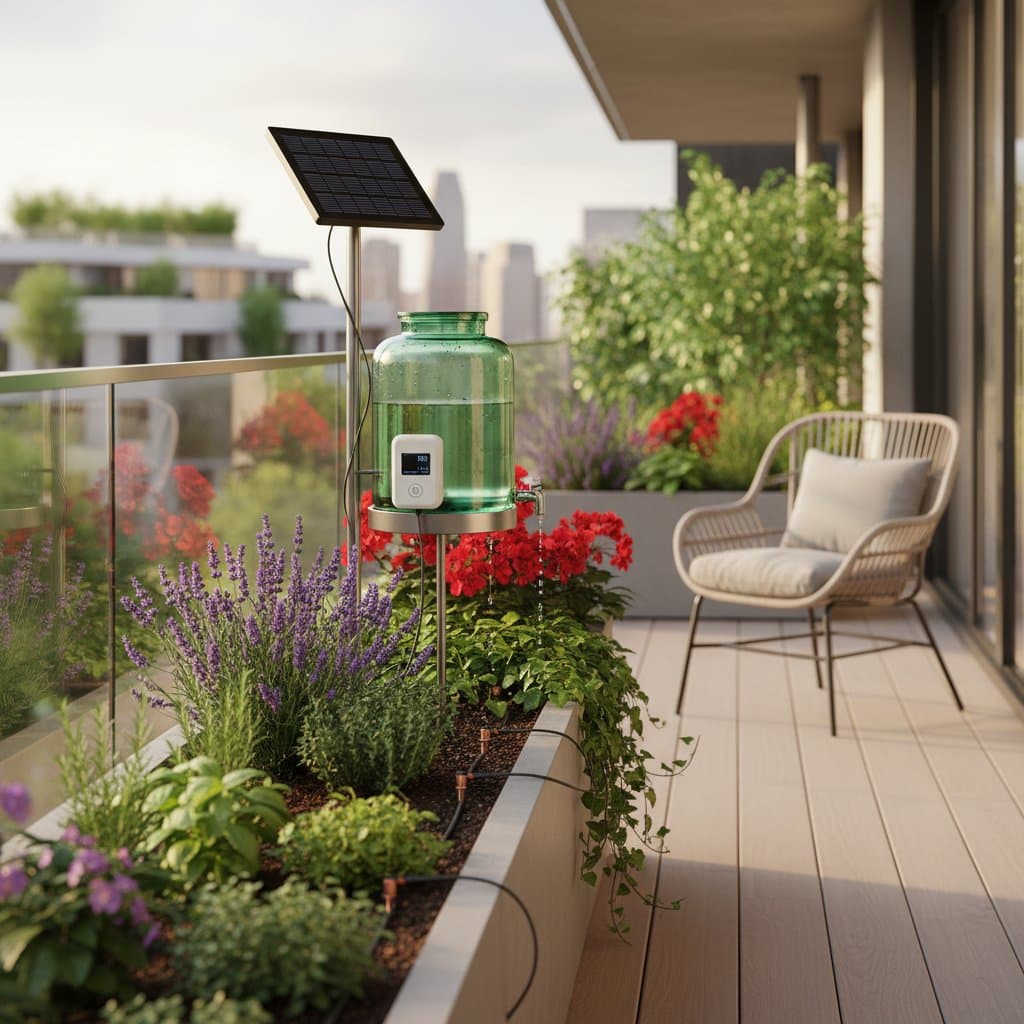
Keep Your Balcony Blooming with Solar Auto-Watering
Balcony gardening offers a touch of nature in urban settings, yet consistent watering presents a persistent challenge. Busy schedules and travel often lead to neglected plants and wilted greenery. A solar auto-watering system addresses these issues by automating hydration through sunlight-powered technology. This approach requires initial setup but delivers reliable results with minimal ongoing intervention.
This guide covers the essentials of solar auto-watering systems, their operation in compact balcony environments, and precise installation methods. Readers gain insights into maintenance practices that ensure longevity across seasons. By the end, individuals possess the knowledge to implement this solution effectively.
Overview
A solar auto-watering system employs a compact solar panel to energize a submersible pump. The pump extracts water from a reservoir and distributes it via drip lines or targeted emitters to plant roots. Advanced models incorporate soil moisture sensors that activate the pump only when necessary, while basic versions operate on preset timers.
In balcony applications, these systems excel due to their compact design and efficiency. They conserve water by delivering precise amounts directly to the soil, reducing evaporation and runoff. Off-grid functionality eliminates the need for electrical outlets, making them suitable for apartments and rental properties. Plants receive steady moisture, fostering robust growth without daily human oversight.
Key advantages include:
- A reduction in manual watering efforts by at least 80 percent
- Uniform soil moisture levels that enhance nutrient absorption and root development
- Reliance on renewable solar energy, incurring no additional utility costs
- Compatibility with diverse setups, from individual pots to linear railing gardens
Tools and Materials
Complete kits simplify acquisition, available through online retailers or specialty garden centers. For a typical balcony supporting 6 to 10 containers, assemble the following components:
- One solar-powered pump kit featuring a panel rated at 2 to 5 watts for adequate daily operation
- A water reservoir, such as a 3- to 5-gallon (11- to 19-liter) durable plastic container
- 10 to 20 feet (3 to 6 meters) of flexible drip tubing, 1/4-inch diameter for precise flow
- 10 to 12 adjustable drip emitters or soil stakes to regulate output per plant
- One inline backflow preventer valve to safeguard against contamination
- Zip ties, adhesive clips, or hooks for securing tubes and cables neatly
Kits often bundle these items, streamlining the process. Verify specifications like pump flow rate, ideally 0.3 to 1 gallon per minute, to match balcony scale. Select UV-resistant materials to withstand outdoor exposure.
Steps
1. Plan Your Layout
Map the positions of all planters and designate a stable location for the reservoir, preferably in partial shade to inhibit algae growth. Account for sunlight patterns throughout the day to optimize panel placement. Measure distances between components to determine required tubing length, ensuring routes avoid high-traffic areas.
2. Mount the Solar Panel
Position the panel to capture a minimum of 4 hours of direct sunlight daily, ideally facing south in the Northern Hemisphere. Secure it using the provided mounting bracket to a railing, wall, or freestanding stand. Route the connecting cable along protected paths, employing clips to prevent dangling or obstruction.
3. Connect the Pump and Tubing
Submerge the pump in the reservoir and attach the inlet hose securely. Link the outlet to the main drip line using barbed connectors, then reinforce joints with hose clamps for leak prevention. Position the pump at or below the water level to facilitate priming and consistent suction.
4. Install Emitters
Assign one emitter to each small pot under 12 inches (30 centimeters) in diameter; use two for larger vessels. Insert emitters 1 to 2 inches into the soil adjacent to plant stems, adjusting for even coverage. For multi-plant containers, space emitters to reach all roots without overlap.
5. Test the Flow
Fill the reservoir with fresh water and activate the system. Observe distribution for 5 to 10 minutes, tweaking emitter adjustments to achieve uniform drips of 1 to 2 drops per second per plant. Address pooling by elevating tubing ends or selecting lower-flow emitters.
6. Set Timer or Sensor
For timer-equipped systems, program initial cycles of 10 to 15 minutes, twice daily, monitoring soil for the first week. Calibrate sensors by inserting probes into representative soil samples and following manufacturer guidelines for threshold settings. Fine-tune based on plant types and weather variations.
Safety Tips
Maintain all electrical components elevated and shielded from moisture to prevent short circuits. Operate the pump only with sufficient water to avoid dry-running damage. Source water from potable supplies and refrain from introducing fertilizers into the reservoir unless the equipment specifies compatibility.
Troubleshooting
If flow diminishes, inspect tubing for bends or blockages and flush emitters with a vinegar-water solution to dissolve deposits. For non-starting pumps, verify unobstructed sunlight on the panel; test by directing a bright light source to simulate conditions. To resolve uneven distribution, standardize tubing lengths among similarly elevated planters or use risers for lower ones.
Budget and Time
Entry-level kits range from $50 to $150, depending on capacity and features like sensors. Basic setups require 1 to 2 hours for assembly and testing, while custom configurations may extend to 4 hours. Ongoing costs remain low, limited to occasional tubing replacements every 2 to 3 years at under $20.
Seasonal Reminders
During peak summer heat, extend watering intervals and inspect reservoir levels bi-daily to combat evaporation. In autumn and spring, moderate cycles to once daily, adjusting for reduced sunlight. Winter preparations involve draining lines, insulating exposed parts, and storing sensitive components indoors to avert freeze damage.
When to Call a Professional
Seek expert assistance if balcony structures require structural modifications for mounting, or if electrical adaptations exceed basic solar setups. Professionals also prove valuable for troubleshooting persistent pump failures or integrating systems with larger irrigation networks.
Steps to Implement Your System
Begin by assessing balcony dimensions and inventorying planters to gauge system scale. Research kits compatible with available sunlight and plant varieties. Proceed with installation promptly to establish automated care, yielding vibrant, low-maintenance greenery that enhances urban living.