
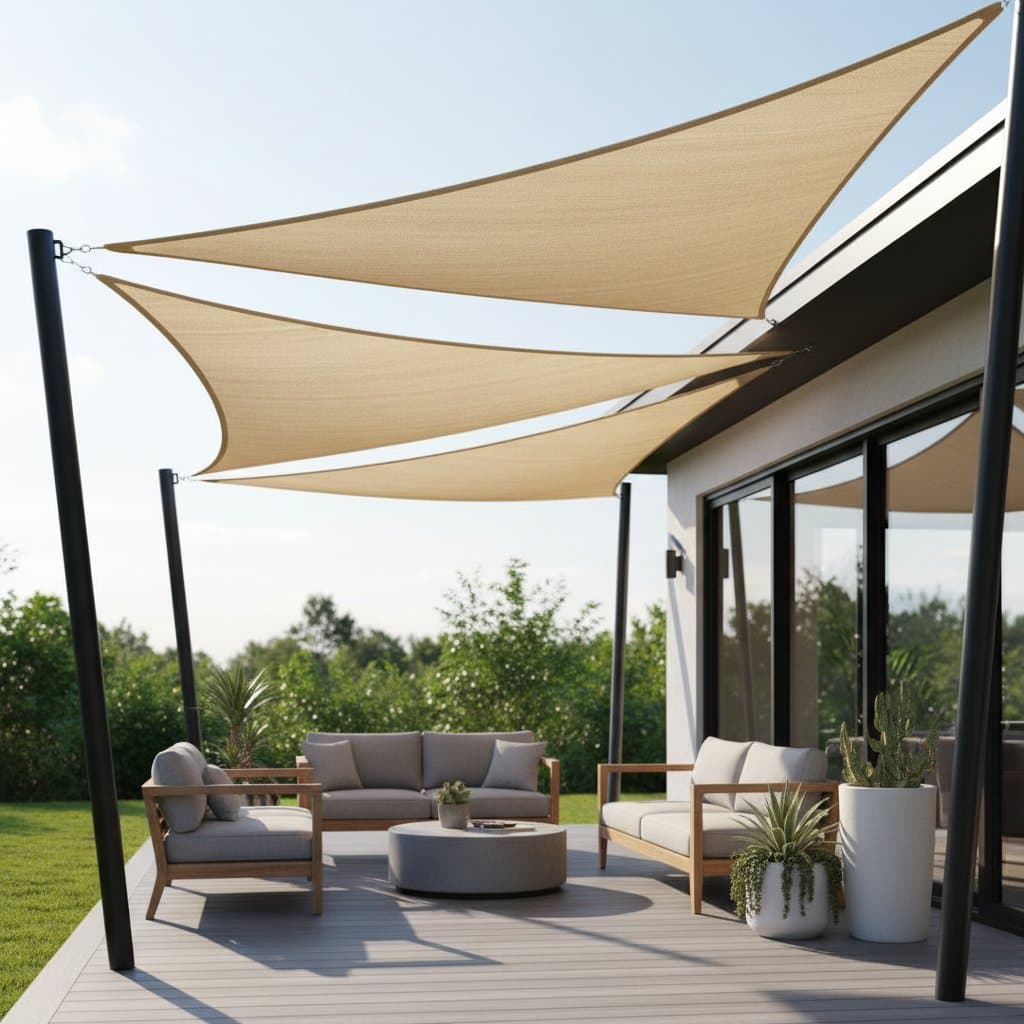
Enhance Small Deck Comfort with UV-Blocking Shade Sails
Small decks often suffer from intense sunlight exposure. Temperatures rise quickly, surfaces discolor, and occupants seek indoor relief. The solution involves creating shade without permanent fixtures. UV-blocking shade sails provide diffused sunlight, enhanced privacy, and reduced heat through a straightforward installation process. This guide covers their features, setup procedures, and ongoing maintenance for seasonal reliability.
Understanding Shade Sails
A shade sail consists of a fabric panel stretched between fixed points to form a protective overhead cover. The design mimics a sail, hence the name. Contemporary models employ high-density polyethylene or solution-dyed acrylic materials that filter up to 95 percent of ultraviolet radiation. Positioned over a deck, such a sail diminishes solar heat gain, prevents upholstery and wood from bleaching, and minimizes visual strain from bright light. Installation requires only a few hours and basic equipment.
Flexibility stands out as a primary advantage. Users adjust the elevation and orientation as needed, combine several sails for comprehensive coverage, or remove them during off-seasons. This adaptability contrasts with rigid alternatives like pergolas, allowing the shade to adapt to changing needs and spatial arrangements.
Essential Tools and Materials
Assemble a robust set of components for a dependable installation. Collect the following items prior to beginning:
- Shade sail dimensioned appropriately for the deck area. Assess the maximum span and opt for a sail 1 to 2 feet shorter to accommodate proper tension.
- Mounting hardware kit including turnbuckles, pad eyes, snap hooks, and corrosion-resistant screws. Select stainless steel components to withstand weather exposure.
- Power drill equipped with bits suitable for wood or masonry substrates.
- Tape measure and stable ladder for precise measurements and access.
- Supplementary rope or cord for initial alignment.
- Spirit level or inclinometer to establish drainage angles.
Enlist assistance for handling, as tensioned fabric exerts significant force on attachment points.
Installation Process
1. Planning and Measurement
Outline the deck boundaries using temporary markers like masking tape or chalk lines. Locate suitable attachment sites, including exterior walls, sturdy posts, or overhead beams. Every corner requires a load-bearing anchor capable of supporting outdoor stresses. Establish a minimum pitch of 10 inches over every 10 feet to facilitate water shedding.
2. Securing Anchor Points
Drill holes for pad eyes or eye bolts at designated locations. In wooden structures, create pilot holes marginally narrower than the fastener diameter to prevent splitting. For concrete or brick, employ sleeve anchors sized to the hardware. Align anchors horizontally on one edge and elevate the opposing edge to achieve the desired incline. Protect eyes with safety goggles during drilling operations.
3. Connecting the Fabric Corners
Secure one corner of the sail to an anchor via a snap hook or D-shackle. Proceed to the adjacent point and insert a turnbuckle between the fabric edge and the anchor. Position each turnbuckle partially extended to allow for subsequent adjustments. Repeat for all attachment points.
4. Applying Tension
Gradually tighten the turnbuckles in sequence until the fabric achieves a firm, wrinkle-free state with slight catenary curves at the edges. Avoid excessive stretching, which could compromise the material. Verify that all corners align properly and the overall form remains balanced. Insufficient tension leads to billowing and accelerated deterioration.
5. Verifying Stability
Test each attachment by applying moderate downward pressure to ensure secure hold. Inspect for any lateral movement or rotation. Confirm that wall-mounted fasteners penetrate structural members rather than surface layers. Posts should measure at least 4 by 4 inches and embed in concrete footings for optimal support. Reliability in anchors underpins the entire system's safety.
Key Safety Considerations
Avoid securing to fragile elements such as picket fences, narrow trim boards, or rain gutters. Maintain unobstructed space beneath the installation to prevent collisions with fittings or lines. Dismantle the sail ahead of severe weather events. Wear protective gloves when manipulating hardware to avoid injury from sharp edges.
Common Issues and Solutions
Excessive Sagging: Release tension on one turnbuckle, elevate the counterpoint by 2 to 3 inches, and re-secure. Diagonal adjustments promote effective water dispersal.
Accumulated Water: Steepen the angle or relocate an anchor higher. A 15-degree configuration typically outperforms level installations for drainage.
Damaged Edges or Seams: Remove stray fibers and apply a controlled flame to seal cuts. For major tears, mend with thread rated for ultraviolet resistance.
Corroded Fittings: Treat affected areas with a diluted vinegar wash, then rinse and dry thoroughly prior to reuse.
Routine Maintenance Practices
Preserve the sail's integrity and appearance through regular upkeep:
- Clean periodically using a soft-bristle brush, neutral soap solution, and fresh water.
- Steer clear of harsh chemicals or bleaches that degrade the weave.
- Flush residues completely and allow natural drying before reattachment.
- Examine fasteners for signs of oxidation and substitute worn parts promptly.
- Readjust tension at the onset of each season to counteract settling.
Quality sails endure 5 to 10 years under moderate conditions, contingent on material specifications and environmental factors.
Off-Season Storage Procedures
- Gradually loosen all turnbuckles to relieve stress.
- Detach corners sequentially, with support to manage the fabric's weight.
- Thoroughly clean and ensure complete dryness.
- Fold neatly and place in a ventilated container in a temperate, arid location.
Protect from proximity to abrasive objects or corrosive substances. Periodically inspect stored items for moisture buildup, which fosters mold growth.
Cost and Time Estimates
A triangular or rectangular sail suitable for compact decks ranges from $60 to $200, based on dimensions and material durability. Associated hardware adds $30 to $50. DIY installation typically requires 2 to 3 hours. Professional services begin at $300, covering labor and reinforcements. This approach proves far more economical than constructing a traditional arbor, which often exceeds $1,000.
Adapting to Seasons
During peak warmth, maintain tautness and cleanliness to maximize ultraviolet filtration at 95 percent. Such coverage shields deck surfaces and textiles from rapid degradation. In winter or stormy periods, remove the installation to avert strain from accumulated precipitation or frost.
Residents in high-wind zones benefit from permeable mesh options offering 70 to 85 percent shade, which permit breeze passage. For maximum shielding, select opaque high-density polyethylene variants certified for full-spectrum block.
Professional Assistance Indicators
Engage a qualified specialist when:
- Anchoring involves masonry, poured concrete, or load-bearing frameworks.
- Designs incorporate multiple overlapping sails with complex rigging.
- Existing supports exhibit instability or fractures.
Experts assess structural integrity, comply with regional regulations, and recommend suitable components. Inquire about tensile capacities, material guarantees, and installation warranties to safeguard the setup.
Implementing Your Shade Solution
Achieve a shaded deck enhancement in a single session using one well-chosen sail. Begin with accurate space evaluation, select ultraviolet-resistant material, and establish firm fixings.
Immediate Steps to Advance Your Project:
- Assess Dimensions: Gauge the deck perimeter and diagram potential anchors. This blueprint guides sail selection.
- Evaluate Materials: Prioritize options blocking 90 to 95 percent of rays; opt for pale hues to enhance heat deflection.
- Inspect Components: Confirm stainless steel certification on fittings to resist elemental wear.
These measures convert your deck into a temperate, appealing extension of home life. Shade sails deliver aesthetic appeal, thermal relief, and durable safeguarding through an accessible endeavor that extends enjoyable outdoor time.