
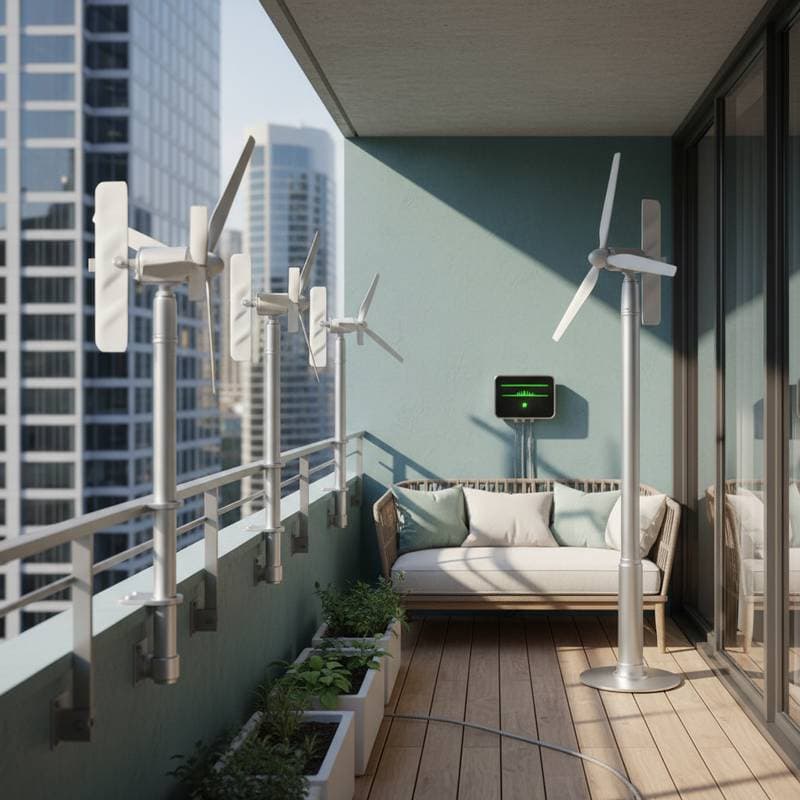
Introduction to Balcony Wind Turbines
Urban living presents unique challenges for sustainable energy, yet city breezes offer untapped potential. Balcony wind turbines provide a compact solution to generate electricity from these winds, ideal for apartments without roof access. These small-scale devices capture gusts between buildings and convert them into usable power, supporting a greener lifestyle in dense environments.
Engineered for residential use, balcony turbines typically feature lightweight blades and quiet operation to comply with urban noise regulations. They produce modest output, sufficient to charge devices or offset minor household loads. By integrating such systems, residents contribute to reduced carbon footprints while gaining independence from traditional grids.
This guide explores the fundamentals, selection process, installation steps, and maintenance essentials. Readers gain practical knowledge to implement these turbines effectively, ensuring safety and efficiency in high-rise settings.
How Balcony Wind Turbines Work
Balcony wind turbines operate on principles similar to larger models but scaled for limited spaces. Wind passes over aerodynamic blades, causing them to rotate and drive an internal generator. This motion produces direct current (DC) electricity, which a charge controller regulates to prevent overcharging connected batteries.
Key components include the turbine head, mounting bracket, charge controller, and storage battery. The turbine head houses the blades and generator, often with a tail fin for self-orientation into the wind. Mounts attach securely to railings or walls, positioning the unit above obstructions for optimal airflow.
Output varies with wind speed and turbine size. Most urban models generate 50 to 400 watts in breezes of 10 to 20 miles per hour, common in city canyons. Consistent performance requires placement in unobstructed areas, away from building shadows that disrupt wind patterns.
Selecting the Right Balcony Turbine
Choose a turbine based on balcony size, wind exposure, and energy needs. Measure available space and railing strength first; models range from 1 to 3 feet in diameter. Prioritize units with carbon fiber or fiberglass blades for durability against urban pollutants.
Assess local wind resources using online maps or anemometers. Aim for average speeds above 8 miles per hour for viable output. Review specifications for rated power, startup speed, and survival wind limits to match city conditions.
Consider certifications for safety and efficiency. Look for models compliant with UL or CE standards, ensuring weather resistance and electrical safety. Budget-friendly options from reputable brands offer warranties of two to five years, balancing cost with reliability.
Evaluate integration features. Some turbines include built-in controllers or app connectivity for monitoring output. Select based on whether you need DC output for batteries or AC via an inverter for household appliances.
1. Prepare the Mounting Area
Inspect your balcony railing for stability. Ensure it supports at least 20 pounds per linear foot, accounting for turbine weight and wind loads. Clean the surface to remove dirt or rust that could weaken adhesion.
Select a spot with clear wind access, ideally facing prevailing directions. Avoid corners where turbulence from adjacent buildings reduces efficiency. Use a level to mark mounting points, spacing them 12 inches apart for secure attachment.
Gather tools: drill with masonry bits, wrench set, screwdriver, and safety gear. If renting, verify lease terms to prevent violations.
2. Assemble the Turbine
Follow the manufacturer's manual to attach blades to the hub. Secure each with provided pins or screws, tightening to specified torque. Connect the tail fin to the nacelle for wind alignment.
Mount the generator housing if detachable. Apply anti-seize compound to rotating parts to ease future maintenance. Test manual rotation to confirm smooth operation without binding.
Package wiring neatly through the mast. Use zip ties to organize cables, preventing tangles during installation.
3. Install the Mount
Attach the bracket to the railing using U-bolts or clamps. For concrete balconies, drill pilot holes and insert expansion anchors. Tighten hardware gradually to avoid stripping threads.
Position the mast at a 10 to 15-degree tilt upward for better wind capture. Secure guy wires if the model requires them for stability in gusts. Double-check alignment with a plumb line.
4. Position the Turbine
Slide the turbine onto the mast and lock it with set screws. Ensure the yaw mechanism allows free rotation. Adjust height to clear balcony furniture by at least 2 feet.
Secure the base with lock nuts to resist vibration. Perform a gentle shake test to verify firmness before proceeding.
5. Connect the System
Run cables from the turbine to the charge controller, routing them along the mount to minimize exposure. Connect positive and negative terminals, observing color coding for polarity. Proceed to link the controller to the battery or power bank.
For AC device compatibility, attach an inverter post-battery. Seal all connections with weatherproof tape or silicone to guard against moisture. Label each wire clearly for future reference and inspections.
6. Test Operation
Await a moderate breeze of 10 miles per hour or more. Observe the blades for smooth rotation without hesitation. The charge controller's indicator light should signal active power flow.
Employ a multimeter to measure voltage at the battery terminals, targeting the manufacturer's rated output. If wobbling occurs, reinforce the mount or insert rubber pads to dampen vibrations.
Safety Tips
Secure all loose items near the turbine, such as planters or hanging lights, to prevent collisions with blades during gusts.
In high wind storms exceeding 30 miles per hour, immobilize the blades or cover the unit to avoid damage.
Restrict access for children and pets, as the rotating parts pose entanglement risks.
Conduct monthly wiring inspections to detect moisture ingress or frayed insulation that could cause shorts.
Adhere to local building codes; certain structures mandate assessments for sound levels or added weight prior to installation.
Troubleshooting Common Issues
Low Power Output:
Inspect for airflow blockages from nearby buildings or trees. Reposition the turbine 1 to 2 feet outward to improve exposure.
Excessive Noise or Vibration:
Incorporate rubber washers or a dedicated vibration pad beneath the mount. Tighten all bolts uniformly to eliminate play.
Blades Fail to Spin:
Manually test rotation; if resistance persists, remove dust or ice from joints. Apply a light coating of silicone spray for lubrication.
No Charging Indication:
Confirm cable polarity matches specifications. Replace corroded connectors promptly. Note that a fully charged battery triggers automatic pauses in the controller.
Shutdown During Heavy Rain:
Examine the housing for water accumulation. Dry components completely before resuming operation.
Budget and Time Considerations
Entry-level balcony turbine kits range from 250 to 600 dollars, varying by size and manufacturer quality. Incorporating a battery and inverter elevates the investment to 700 to 900 dollars.
Most installations complete in one afternoon using basic tools like a drill and wrenches. Additional time, up to one full day, may apply if railing reinforcements or electrical modifications prove necessary.
Returns manifest gradually through consistent savings. A 100- to 200-watt system offsets costs for lighting or gadget charging, yielding several dollars monthly. Cumulative effects diminish grid reliance over years.
Maintenance Essentials
Preserve efficiency through routine upkeep.
Clean blades monthly with mild soap and water, steering clear of harsh chemicals that degrade surfaces.
Examine bolts biannually and tighten as required to counter loosening from vibrations.
Shield cables by encasing exposed lengths in UV-resistant tubing.
Apply one drop of light oil to bearings periodically to maintain fluid rotation.
Maintain a stock of spare parts, including extra blades and pins, for swift post-storm repairs.
Regular care extends turbine lifespan to five to ten years, contingent on brand robustness and environmental factors.
Professional Assistance Scenarios
Engage a licensed electrician for integrations into apartment circuits, ensuring proper grounding and breaker capacity.
For buildings with communal balconies or weight restrictions, seek approval from property management or a structural engineer. Inquire about permissible mounting techniques and load limits.
Professionals assist in configuring multiple units on shared roofs or terraces, optimizing placement to minimize noise and maximize collective airflow.
Optimizing Energy Storage
Effective storage enhances system utility. Opt for deep-cycle batteries suited to renewable sources, positioning them indoors in ventilated, temperature-controlled areas.
Mark each battery with installation date and capacity rating. Replace units when efficiency falls below 80 percent of original performance.
For mobility, pair with DC-input power banks to directly energize phones, laptops, or portable lights from turbine output.
Implementing Your Balcony Power Solution
Begin by evaluating your balcony's wind potential and structural readiness. Acquire a suitable kit and assemble components methodically.
Follow installation protocols precisely, prioritizing safety and secure connections. Monitor initial performance and adjust as needed.
Sustain the system through diligent maintenance, troubleshooting promptly to ensure reliability. Over time, enjoy reduced energy expenses and the satisfaction of urban sustainability contributions.