
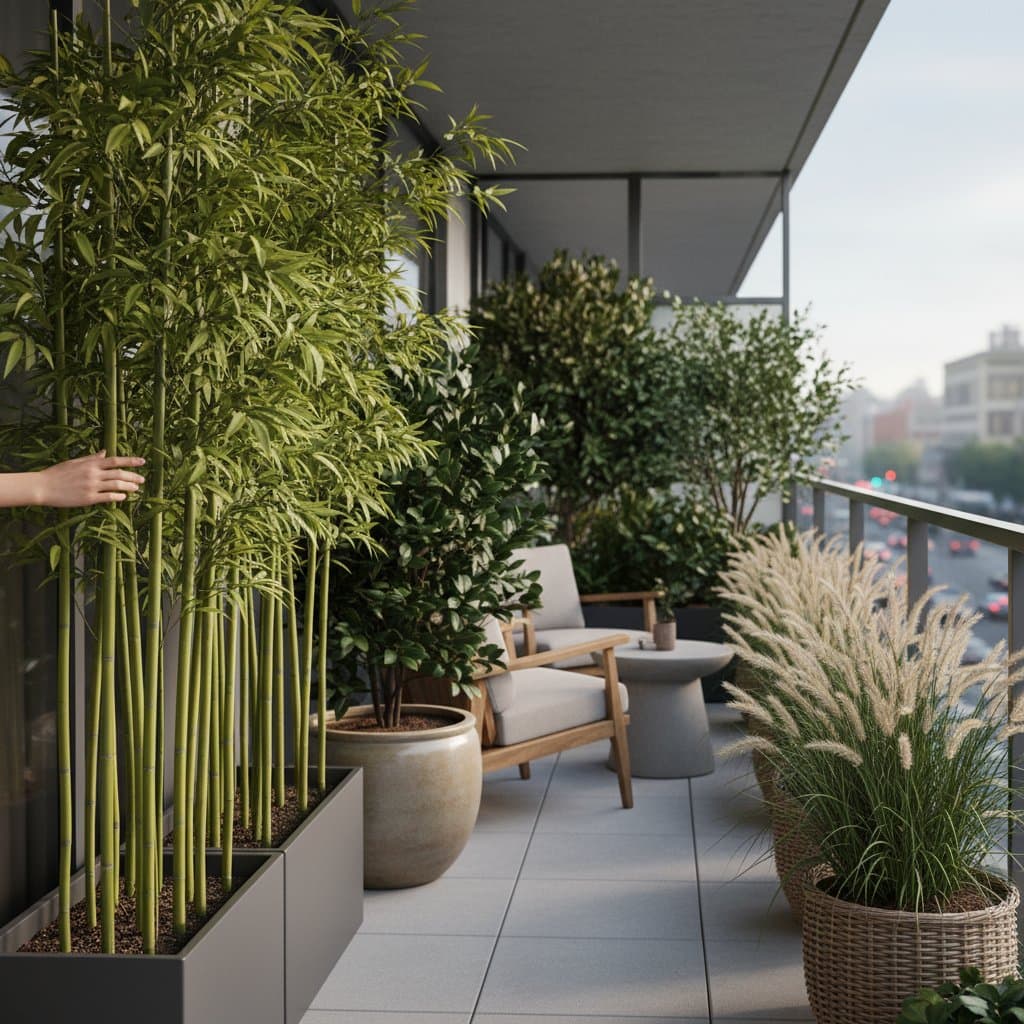
Plants That Block City Noise in Small Urban Spaces
Balconies and courtyards in urban environments deserve to serve as serene retreats rather than amplifiers of traffic and construction sounds. Urban noise erodes tranquility and concentration, yet strategic plantings offer an effective remedy. Greenery softens acoustics, purifies the air, and tempers the heat from surrounding hardscapes. Even in confined areas, layers of vegetation, combined with thoughtful positioning, create substantial sound mitigation without requiring expansive grounds.
This guide details the implementation of living sound barriers suited to compact urban settings. Readers gain insights into optimal plant selections, arrangement techniques, maintenance requirements, and cost considerations for establishing a verdant, hushed sanctuary.
Understanding Sound Mitigation Through Plants
Acoustic waves propagate and reflect off impervious surfaces like concrete, metal, and glass prevalent in cities. Vegetation disrupts these waves effectively. Foliage scatters high-frequency sounds, while dense stems and soil dampen vibrations. A robust hedge or cluster of tall grasses can diminish audible noise levels by multiple decibels, yielding a perceptible enhancement in comfort.
The objective remains a modulated acoustic environment rather than absolute quietude. This fosters mental relaxation amid ambient hums. Employ tall specimens to intercept direct sound paths, mid-level plants to seal interstices, and ground-level covers to quell reverberations from floors and walls.
Essential Tools and Materials
Basic, reliable supplies suffice for this project, eliminating the need for specialized gear:
- Planters or raised beds: Four to six sizable containers for balconies; eight to ten for modest yards.
- Premium soil blend enriched with compost to nurture robust root systems.
- Organic mulch to regulate moisture and enhance acoustic absorption.
- Pruning shears for biannual shaping.
- Watering can or automated drip irrigation system to ensure uniform hydration.
- Durable gloves and a compact trowel for handling.
Secure containers adjacent to railings or rooftops using brackets or ballast to withstand gusts.
Implementation Steps
Step 1: Assess and Plan Your Space
Record precise dimensions: overall length, width, and the predominant noise source. Urban clamor typically originates from a single direction, such as a thoroughfare or passageway. Position the uppermost plant tier opposite this source to maximize interception.
Step 2: Select Tall, Dense Anchor Plants
Opt for evergreen or semi-evergreen varieties to maintain year-round screening. In space-constrained spots, prioritize cultivars adaptable to pots, reaching heights of five to seven feet.
Recommended choices include:
- Clumping bamboo varieties like Fargesia rufa: Upright growth forms a thicket ideal for containment.
- Arborvitae: Suited for linear privacy barriers with minimal spread.
- Holly or cherry laurel: Provide lush, malleable foliage for sculpting.
Space these anchors 12 to 18 inches apart to form an unbroken screen.
Step 3: Incorporate Mid- and Low-Level Layers
Acoustic gaps undermine barriers, so integrate complementary heights. Position mid-tier shrubs or grasses amid the taller elements.
Effective selections:
- Boxwood: Neat, responsive to pruning for structured fills.
- Miscanthus or switchgrass: Graceful motion diffuses sound waves dynamically.
- Hostas or ferns: Shade-tolerant options that cloak soil and muffle ground-level echoes.
This multi-tiered approach constructs a resilient acoustic veil operating across elevations.
Step 4: Integrate Vines and Vertical Elements
For minimal floor area, exploit vertical planes. Train vines along trellises or install modular living walls to capture noise aloft. Hardy climbers such as English ivy or Boston ivy excel in such applications. In sunnier exposures, jasmine or trumpet vine add fragrance and vitality. Maintain a four-inch clearance from structures to promote circulation and avert fungal issues.
Step 5: Diversify Textures for Enhanced Effectiveness
Differing leaf morphologies intercept varied sound spectra. Blend broad-leaved and needle-like plants, incorporating at least three distinct textures. Such variety not only bolsters auditory damping but also enriches visual appeal, evoking a soothing, layered habitat.
Safety Considerations
Don protective gloves during pruning of thorny species like holly. Stabilize heavy planters, which may exceed 80 pounds when filled, and verify structural load capacities for elevated installations. Select non-invasive bamboo and climbers to safeguard building integrity. Ensure plantings do not obstruct egress routes or ventilation systems.
Common Challenges and Solutions
If residual noise persists, introduce an additional tier or consolidate planters to minimize voids; a mere four-inch shift often suffices. Rapid desiccation in breezy locales demands two-inch mulch layers or slow-drip irrigation. Yellowing foliage signals drainage issues; employ perforated pots with saucers to prevent waterlogging. For pest incursions, apply a monthly rinse of dilute soapy solution, as vigorous plants naturally deter urban insects.
Cost and Timeline Estimates
A foundational array of six to eight containers typically ranges from $150 to $300. Investments in bamboo or evergreens yield longevity over annual grasses. Supplementary soil and mulch contribute another $30 to $50.
Allocate two half-day sessions: one for site evaluation and planting, the other for fixation and initial irrigation. Ongoing care requires approximately 15 minutes weekly for hydration and light trimming.
Ongoing Care Practices
Sustain hydration, as elevated urban sites desiccate more swiftly than in-ground plantings. Apply slow-release fertilizer biannually. Prune twice yearly to preserve form and control stature. Annually scrutinize for container wear or root constriction, upgrading to vessels two inches broader as needed.
Vigorous density underpins acoustic performance; consistent grooming and nutrition ensure a fortified barrier.
Efficient Storage Solutions
Position tools and essentials for effortless access to promote adherence. A bench with integrated storage or wall-hung organizer accommodates shears, gloves, and irrigation components. Organized labeling streamlines routines.
Engaging Professional Assistance
Consult experts for balcony reinforcements exceeding standard loads or intricate vertical installations. Landscape architects can optimize designs for severe noise profiles or heritage constraints. Arborists address specialized pruning for mature specimens.
Building Your Sound Sanctuary
Commence modestly by aligning three tall planters against the primary noise front; evaluate acoustics after seven days. Subsequently, layer in mid-height fillers or suspend vertical gardens on opposing faces. Experiment with positional tweaks relative to boundaries to refine damping.
A weekend investment yields immediate acoustic relief. As foliage matures, the gentle rustle supplants urban din, cultivating enduring peace in your green enclave.