
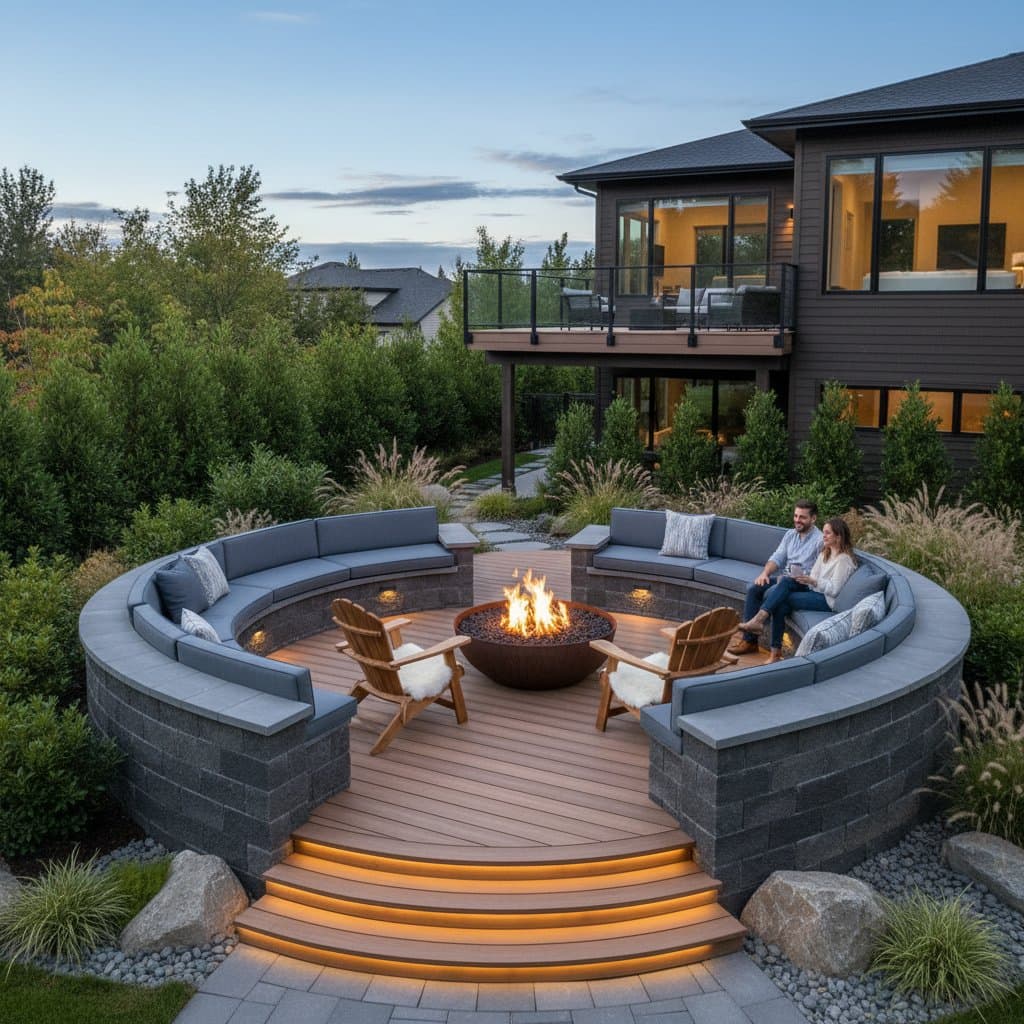
Why Fire Pit Decks with Seating Walls Are Trending
Homeowners seek outdoor spaces that provide year-round comfort and functionality. A fire pit deck integrated with a built-in seating wall achieves this by delivering warmth, illumination, and dedicated gathering areas without the need for scattered furniture. The result is a secure, durable installation that encourages extended outdoor time.
This guide details the popularity of these designs, their operational principles, and essential planning considerations for residential implementation.
Overview
A fire pit deck with a seating wall merges two fundamental outdoor elements into a cohesive unit. The fire pit serves as the focal point, while the seating wall delineates the area, incorporates benches, and maintains a streamlined appearance. This combination establishes a defined zone that appears complete and efficient in space utilization.
Such setups adapt well to urban terraces and suburban yards alike. They simplify maintenance and enhance safety during use. Property owners value the casual yet intentional aesthetic, which accommodates diverse living preferences.
Why the Trend Matters
Individuals desire exterior environments that rival the coziness of indoor rooms. Built-in seating walls eliminate the need for cushions or frequent repositioning. These structures remain stable amid varying weather conditions and present a neat profile from multiple viewpoints. When combined with a fire pit, they form a versatile area that promotes indoor-to-outdoor transitions.
The fire feature introduces warmth and dynamic visual interest. It prolongs deck usability into cooler periods. Families employ it for cooking over flames, serene evenings, or intimate assemblies. The wall establishes distinct boundaries, guiding guest placement and ensuring orderly arrangement.
Landscape professionals attribute the trend's rise to its longevity. One builder noted, "A constructed wall endures season after season." This reliability spares owners the expense of substituting weathered chairs, appealing to those prioritizing minimal maintenance alongside superior comfort.
Smart Design Choices
Effective fire pit deck planning begins with thoughtful spatial arrangement. Position the fire pit at minimum 10 feet (3 meters) from the residence and any combustible materials. Shape the seating wall in a subtle arc or semicircle encircling the pit, preserving ample room for circulation and ventilation.
Key design tips:
- Maintain wall height at 18 to 22 inches (45 to 55 centimeters) to support ergonomic seating.
- Provide 3 feet (1 meter) of space between the wall and fire pit to accommodate leg extension.
- Select stone, concrete blocks, or composites engineered to withstand heat and humidity.
- Incorporate concealed storage beneath the wall cap for utensils or propane canisters.
Illumination plays a crucial role. Install low-voltage fixtures along the wall cap or deck perimeter to bolster nighttime safety and extend usability.
Tools and Materials
Construct a modest installation independently or engage professionals for intricate configurations. Regardless, prioritize premium components suited to thermal and environmental stresses.
Basic materials:
- Fire pit assembly or metal liner
- Concrete blocks or quarried stone for the wall
- Polymer sand and gravel foundation
- Fire-resistant mortar
- Deck planking from treated lumber or synthetics
- Thermal barrier or protective mat for the deck surface
Tools:
- Spirit level, measuring tape, and chalk line
- Masonry cutter or angle grinder
- Pointing trowel and mortar tub
- Safety gloves and goggles
Consult product guidelines for fuel mechanisms. Licensed specialists must handle propane or natural gas connections.
Safety Tips
Integrating fire with deck surfaces requires precise construction to mitigate risks. Adhere to these protocols:
- Safeguard the base. Install a non-combustible pad beneath the pit on wooden or synthetic decks.
- Uphold distances. Ensure 10 feet (3 meters) separation from barriers, exterior walls, or vegetation.
- Facilitate airflow. Equip deck enclosures with openings to dissipate heat.
- Employ screens. Use mesh covers to contain sparks and prevent ignition of nearby flammables.
- Supervise actively. Quench residues completely using sand or water prior to vacating the area.
These practices avert the majority of incidents and prolong material integrity.
Budget and Time
A basic fire pit deck featuring a compact seating wall typically ranges from $2,000 to $4,000. Expansive stone constructions or integrated gas setups may escalate to $8,000 through $10,000. Expenses fluctuate based on selections and regional factors. Self-performed labor can halve outlays, though allocate two full weekends minimum.
Gas installations or structural modifications often necessitate approvals. Contact the municipal authority to verify obligations. Compliance avoids penalties or demolition expenses exceeding initial fees.
Maintenance and Care
Built-in seating walls demand minimal attention. Regularly clear surface debris and apply a water rinse monthly. For masonry, refresh sealant in joints every few years to repel water infiltration. Synthetic decking responds to gentle detergent and bristle brushing.
Seasonally evaluate the fire pit:
- Clear accumulated residue.
- Examine metallic elements for corrosion.
- Substitute damaged stones or inserts promptly.
For gaseous models, clear orifice ports with a stiff brush to sustain uniform combustion. Keep protective tarps accessible for idle periods.
When to Call a Pro
Engage experts for:
- Gas piping or wired illumination additions.
- Elevated deck constructions.
- Expansions altering the deck's dimensions or framework.
Implementing Your Design
To bring a fire pit deck with seating wall to life, commence with basic visualization. Diagram your terrain, delineate a secure perimeter for the fire feature, and envision seating placements. Opt for resilient options aligned with your aesthetic and financial parameters.
The outcome yields a seamless hub for social interaction. It delivers thermal comfort, defined organization, and persistent appeal across seasons.